The onboarding time sink
Every service business has an onboarding process. And almost every one of them is held together with duct tape and good intentions.
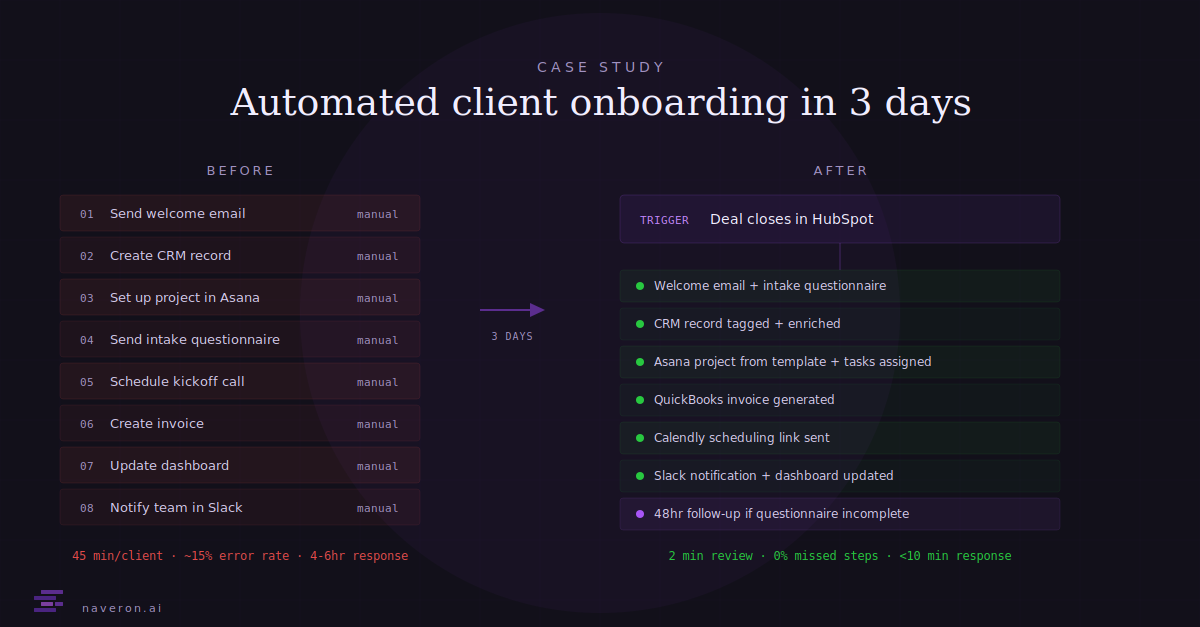
A new client signs. Someone on your team sends a welcome email. Then they create a record in the CRM. Then they set up a project in your PM tool. Then they send a questionnaire. Then they schedule a kickoff call. Then they create an invoice. Then they add them to your reporting dashboard. Then they notify the team in Slack.
Eight steps. Four tools. Forty-five minutes per client. And if someone forgets step three, nobody finds out until the client emails asking why their project isn't in the system.
This is what we fixed.
The client's setup (before)
The business was a professional services firm. About 15 employees, growing fast, onboarding 8-12 new clients per month. Their stack looked like most small businesses: HubSpot for CRM, Asana for project management, QuickBooks for invoicing, and Google Workspace for everything else.
The onboarding process was documented in a Google Doc that nobody had updated in six months. The person who usually handled it was the office manager. When she was out, things fell through the cracks. When two clients signed on the same day, everything backed up.
What we built
The goal was simple: new client signs → everything happens automatically. No human touches the process unless something unusual comes up. Business operations automation cuts manual work to nearly zero.
Here's the flow we designed and deployed:
Trigger: A deal moves to "Closed Won" in HubSpot. That's the starting gun. Everything downstream fires from that single event.
Step 1: Welcome sequence. The system sends a personalized welcome email with the client's name, their project details, and a link to a pre-built intake questionnaire. The email looks like it came from the account manager. Because it has their name, their email, and their signature. The client has no idea it was automated.
Step 2: CRM enrichment. The contact record in HubSpot gets auto-tagged with the service type, expected timeline, and assigned team lead. Custom properties we defined in discovery.
Step 3: Project creation. An Asana project spins up from a template specific to that service type. Tasks pre-assigned, due dates auto-calculated from the deal close date, dependencies already wired.
Step 4: Invoice generation. QuickBooks creates a draft invoice using the deal amount from HubSpot. Payment terms, line items, and client info all pulled automatically. The office manager just reviews and hits send.
Step 5: Kickoff scheduling. A Calendly link goes out with pre-selected availability for the assigned team lead. Client books themselves. Calendar invite fires to both parties.
Step 6: Team notification. Slack gets a formatted message in the projects channel: who the client is, what they bought, who's leading it, and when kickoff is. Plus a link to the Asana project.
Step 7: Dashboard update. The client gets added to their internal reporting sheet. Revenue, timeline, and status all tracked automatically from that point forward.
Step 8: Exception routing. If the intake questionnaire isn't completed within 48 hours, a follow-up email sends automatically. If it's still incomplete after 72 hours, the account manager gets a Slack ping to follow up manually.
The timeline
Day 1: Discovery and architecture. We mapped the existing process, identified every tool and handoff, and designed the automation flow. We also set up the API connections between HubSpot, Asana, QuickBooks, Google Workspace, Slack, and Calendly.
Day 2: Build. We wired the entire flow, built the email templates, created the Asana project templates, and configured the exception handling logic. Tested internally with dummy data.
Day 3: Testing and launch. Ran three real clients through the system with the office manager watching. Caught two edge cases (one deal had no assigned team lead, another had a service type that didn't match any template). Fixed both in under an hour. Went live that afternoon.
The results
First month after deployment:
45 minutes per client → under 2 minutes of human review. The office manager now just checks the auto-generated invoice and hits send. Everything else is hands-off.
Zero missed steps. The old process had a ~15% error rate where at least one step got skipped or delayed. In the first month, every client went through the full flow without a single miss.
Client response time dropped from 4-6 hours to under 10 minutes. Welcome emails and intake questionnaires now go out immediately when a deal closes, not whenever someone gets around to it.
The office manager got 8+ hours per month back. Time she now spends on work that actually requires a human brain.
What this means for your business
This wasn't a complicated build. No custom AI models. No machine learning. Just smart workflow automation connecting tools the business already owned.
If your onboarding process involves more than three manual steps across more than one tool, it can probably be automated. The question isn't whether the technology exists. It does. The question is whether the person building it understands your business well enough to get the details right.
That's the part we obsess over.